
What Does It Mean to Approach Ayahuasca as a Sacrament?
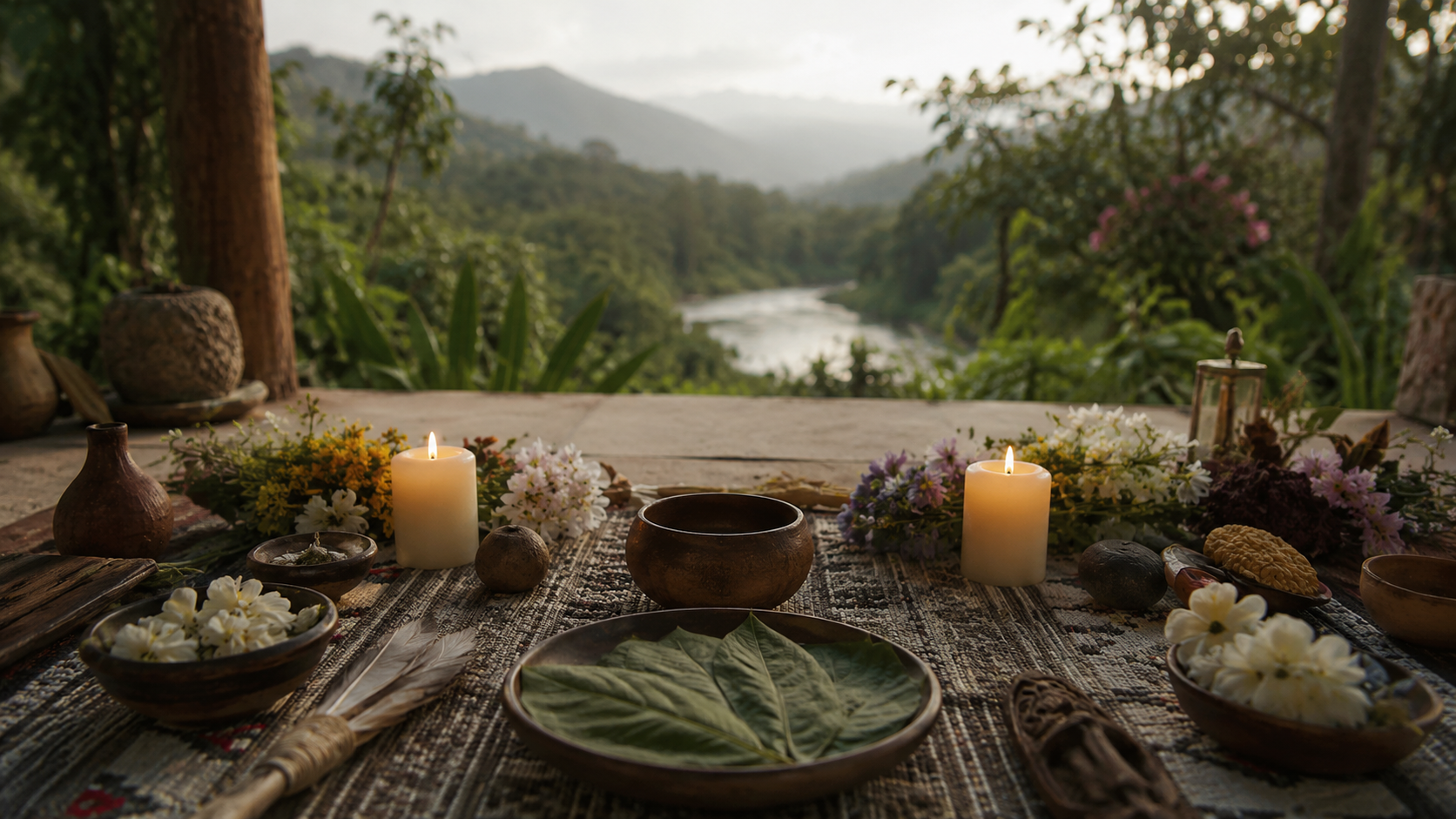
Ayahuasca is often spoken about as a plant medicine, a psychedelic, a healing tool, or a doorway into altered states of consciousness.
At Agape Church, we approach Ayahuasca and Yagé as religious sacraments.
That distinction shapes everything.
It shapes how we prepare.
How we gather.
How we pray.
How we receive what is revealed.
And how we carry the experience into our lives afterward.
To approach Ayahuasca as a sacrament is not simply to change the language around the experience. It is to enter into a different relationship with it.
One rooted in reverence, humility, faith, responsibility, and prayer.
A Sacrament Is Not a Product
A sacrament is not something we consume for entertainment, curiosity, or personal optimization.
It is not a product promising transformation.
It is not a shortcut around the work of being human.
A sacrament is received within a sacred relationship.
At Agape, Ayahuasca is not sold as a commodity, and we do not charge for the sacrament itself. Donations support the retreat, including lodging, meals, preparation, facilitation, integration, and the many practical responsibilities required to hold a safe and reverent gathering.
The sacrament remains sacred.
It is not measured by the amount someone gives, the intensity of their experience, or whether they receive the answer they hoped for.
We enter prayerfully and allow the experience to unfold without demanding that it prove its value.
Ayahuasca Is a Sacrament, Not a Deity
We do not worship Ayahuasca.
We do not ask participants to replace their faith, abandon their relationship with God, or accept one spiritual tradition as the only path.
Ayahuasca is a sacrament through which a person may enter deeper prayer, reflection, remembrance, repentance, gratitude, or communion with the Divine Creator.
The sacrament may help reveal something.
It may bring attention to something that has been avoided.
It may soften the heart, challenge the ego, expose grief, or return a person to a truth they already carried.
But the sacrament is not God.
It does not replace discernment.
It does not remove personal responsibility.
It does not have the final authority over your life.
At Agape, our invitation is simple:
Pray with me to the God of your choice.
Ceremony Is Prayer
When Ayahuasca is approached as a sacrament, ceremony becomes more than the setting in which it is consumed.
The ceremony itself becomes prayer.
Prayer may take many forms.
It may be spoken aloud or held silently.
It may come through music, tears, stillness, breath, gratitude, confession, fear, surrender, or the simple willingness to remain present.
Some participants arrive with a clear relationship to God.
Others arrive uncertain.
Some carry Christian faith.
Others come from Indigenous, Hindu, Buddhist, Jewish, Muslim, interfaith, or personally defined spiritual paths.
Some are still trying to understand what they believe.
We do not require everyone to use the same name for the Divine.
We ask that each person enter with sincerity and respect.
The shared prayer is not sameness.
It is reverence.
Faith Is Different From Expectation
Many people prepare for Ayahuasca by forming an intention.
An intention can be helpful, but it should not become a demand.
You may arrive seeking clarity about a relationship, grief, addiction, purpose, family, forgiveness, or a difficult season of life.
You may hope to understand why something happened.
You may want relief from a pattern you are tired of carrying.
These prayers matter.
But approaching the sacrament with faith means leaving room for an answer that does not look the way you imagined.
Faith says:
I will prepare sincerely.
I will enter with reverence.
I will remain open.
I will receive what I am able to receive.
Expectation says:
Show me what I asked for.
Make me feel better.
Give me certainty.
Prove that this was worth it.
Sacred ceremony does not exist to obey our demands.
We bring our prayers and allow grace to meet us as it will.
Reverence Does Not Require Fear
To treat Ayahuasca as sacred does not mean approaching it with superstition, intimidation, or blind obedience.
Reverence is not fear.
It is respect.
It is recognizing that the experience may reach places within us that are tender, unresolved, or difficult to explain.
It is understanding that spiritual vulnerability should be held carefully.
It is preparing the body and mind instead of arriving casually.
It is respecting the people gathered around us.
It is listening to guidance without surrendering our spiritual sovereignty.
It is remaining humble enough to admit that not everything experienced in ceremony will be immediately understood.
Reverence allows us to enter sincerely without pretending that facilitators, musicians, visions, or spiritual impressions are beyond question.
Spiritual Sovereignty Remains With You
A facilitator may support you.
A song may move you.
A prayer may open something.
A ceremony may reveal an image, memory, emotion, or message that feels deeply important.
But no one else has the authority to define your experience for you.
At Agape, facilitators do not tell participants what their visions mean, what God requires of them, or what major decisions they must make afterward.
We may ask questions.
We may offer context.
We may help you slow down, reflect, and discern.
But your relationship with the Divine remains your own.
Approaching Ayahuasca as a sacrament should deepen spiritual sovereignty, not replace it with dependence on a facilitator, church, tradition, or ceremonial authority.
The purpose is not to create followers of a personality.
It is to help people return more honestly to prayer, responsibility, and relationship.
Membership Is About Religious Relationship
Agape Church is a religious community, and participation in our sacramental retreats begins with membership.
Membership is not an approval process.
It does not guarantee retreat participation.
It establishes that the person understands the church’s beliefs, the sacramental nature of the offering, and the responsibilities of entering sacred ceremony within our community.
Retreat registration is a separate process.
That process allows us to learn more about a participant’s health history, medications, preparation, spiritual understanding, and reasons for seeking the retreat.
This is not done to judge someone’s faith.
It is done because reverence includes responsibility.
A sacrament should not be offered carelessly.
The more sacred we believe the gathering to be, the more seriously we must approach preparation, screening, consent, and safety.
Preparation Is Part of the Religious Practice
Preparation is not simply a list of restrictions before arrival.
It is part of the prayer.
The way you care for your body matters.
The way you organize your responsibilities matters.
The way you speak to the people around you matters.
The way you approach food, medications, substances, entertainment, conflict, and rest may reveal where your attention has been placed.
Preparation creates space.
It gives the participant an opportunity to slow down before ceremony begins.
It may include reviewing medications with a prescribing physician, abstaining from prohibited substances, simplifying food, listening to the music that may be offered, clarifying an intention, notifying an emergency contact, and making sure responsibilities at home are covered.
These actions are practical.
They are also devotional.
They say:
I am not arriving casually.
I am making room for prayer.
The Experience Is Not Measured by Intensity
Some Ayahuasca experiences are visually vivid.
Others are emotional.
Some are physically challenging.
Some feel gentle, quiet, or subtle.
A participant may receive a clear insight.
Another may spend much of the ceremony learning how to remain present with discomfort.
Someone else may feel very little and wonder whether anything happened at all.
None of these experiences automatically indicates spiritual success or failure.
The loudest ceremony is not necessarily the deepest.
A difficult ceremony is not automatically more meaningful.
Purging is not proof of cleansing.
Visions are not proof of spiritual authority.
A peaceful experience is not evidence that someone avoided the work.
When Ayahuasca is approached as a sacrament, we stop trying to grade the ceremony by intensity.
We ask instead:
What is this asking me to notice?
What responsibility follows from what I received?
How does this prayer continue when I return home?
Integration Is Part of the Sacrament
The ceremony does not end when the music stops.
Integration is the process of carrying prayer into daily life.
A powerful insight may feel clear during ceremony and become more complicated once a person returns to relationships, responsibilities, habits, and ordinary routines.
That is where discernment becomes necessary.
Integration may involve:
Rest and nourishment
Prayer
Journaling
Honest conversation
Making amends
Establishing boundaries
Seeking professional support
Returning to spiritual practice
Allowing time before making major decisions
Recognizing where insight must become action
At Agape, integration follows each sacramental offering because we believe continuity matters.
The same facilitators who were present during ceremony may help participants reflect afterward. This gives them context without giving them authority over the participant’s meaning.
The sacrament may reveal something.
Integration asks what you will do with it.
Sacred Ceremony Does Not Remove Human Responsibility
Ayahuasca does not make every thought true.
It does not make every feeling a prophecy.
It does not excuse harmful behavior.
It does not automatically repair relationships.
It does not replace medical care, therapy, accountability, time, or effort.
A person may leave ceremony feeling forgiven while still needing to apologize.
They may feel called to change while still needing to practice that change consistently.
They may understand the origin of a pattern without yet knowing how to stop repeating it.
Sacred experience can open a door.
We still have to walk through it.
Approaching Ayahuasca as a sacrament means accepting that spiritual insight and human responsibility belong together.
Community Matters
Sacramental ceremony does not happen in isolation.
The people gathered affect the space.
Participants may not know one another when they arrive, but they agree to share an environment of vulnerability, prayer, and mutual respect.
This requires care.
Confidentiality matters.
Boundaries matter.
How we speak to one another matters.
How we respond when someone is struggling matters.
How we return the space after using it matters.
Community does not mean everyone must become close friends.
It means recognizing that our presence affects other people.
Sacred ceremony asks us to consider not only what we hope to receive, but what kind of presence we are bringing into the prayer.
What Makes Agape’s Approach Different
Agape is an interfaith church.
We do not carry ceremony in the traditional Shipibo sense, and we do not present ourselves as shamans.
Our way is rooted in:
Seated prayer
Live medicine music
Sacred silence
Reflection
Integration
Shared meals and lodging
Small-group community
Spiritual sovereignty
Teachings received from traditional Taitas and Curanderos
Reverence for the Divine Creator
We are facilitators.
We prepare the space.
We carry the prayer.
We support the people entrusted to our care.
We do not claim ownership over the sacrament or authority over another person’s relationship with God.
The Sacrament Is an Invitation
Approaching Ayahuasca as a sacrament does not require certainty.
It requires sincerity.
You do not need to arrive with every belief settled.
You do not need the perfect prayer.
You do not need to understand everything that may happen.
You are asked to prepare responsibly.
To enter reverently.
To remain open.
To respect the people gathered around you.
To listen without abandoning discernment.
To receive without demanding.
And to carry what is revealed into the way you live.
The sacrament is not the destination.
It is part of the path.
The prayer begins before you arrive.
It continues through ceremony.
And its meaning is revealed by the life you return to.
Explore Sacramental Retreats With Agape
Agape offers intimate Ayahuasca and Yagé retreats rooted in prayer, live medicine music, sacred silence, integration, and spiritual community.
Participation begins with church membership, followed by a separate retreat registration and screening process.